
Regional Horticultural Research and Training Station, Mashobra Mashobra,Shimla (HP)

HON'BLE GOVERNOR
Hon'ble Governor HP

Sh. Kavinder Gupta

HON'BLE GOVERNOR HP

HON'BLE CHIEF MINISTER
Hon'ble Chief Minister HP

Sh. Sukhvinder Singh Sukhu

HON'BLE CHIEF MINISTER HP

🏛
VICE CHANCELLOR
Vice Chancellor

Dr. Harminder Singh Baweja

HON'BLE VICE CHANCELLOR

Regional Horticultural Research and Training Station is located at a distance of 16 kms from Shimla on Shimla-Tattapani- Mandi road. It is situated at 31.1oN latitude and 77.1oE longitude, North West of Shimla with an elevation of 2286 meters above mean sea level. It has an area of 64 acres. This station is playing an important role in research and transfer of technology on temperate fruits-. This station was inherited from an apple orchard planted by Mr. Alexander Coutts, a tailor to the then Viceroy of India Lord Dufferin who originally planted the orchard known as "Hillock's Head" in the year 1887. Later on, it was named as 'Coutt's Garden', where some of famous English varieties of apple such as Yellow Newton, King of Pippin and Granny Smith were also introduced. Since December 1, 1985 it is a leading Regional Horticultural Research and Training Station of Dr.YS Parmar University of Horticulture and Forestry, Nauni, Solan (HP) and centre of excellence for sustainable apple production.
RHR&TS has been honoured to welcome the visits of three Presidents of India namely; His Excellency Dr. Rajendra Prasad, Shri V.V. Giri and Shri R. Venketraman; Vice-President of India, Sh. Hamid Ansari and first Prime Minister of country Pt. Jawahar Lal Nehru besides several Governors, Union Ministers, Chief Ministers and Ministers of different states. In addition, foreign dignitaries particularly scientists, professors, eminent persons, farmers of all the states and tourists all over the world visit station to see fruits and flowers every year.
Mandate

  • Conducting research on temperate fruits and ornamentals plants to cater the need of farmers of wet temperate zone of Himachal Pradesh.
  • Studies on seasonal activity, etiology, epidemiology and integrated management of important insect-pests and diseases of temperate fruit crops.
  • Transfer of technologies generated on temperate fruits and ornamental plants to the farmers of Himachal Pradesh.

Strengths

  • Largest germplasm centre for apple, pear and cherries in India. At present about 291 apples, 91 pears and 51 cherry cultivars are being maintained in the repository.
  • Modern laboratory facilities for establishment of clean plant stock of temperate fruit crops and molecular diagnosis of plant pathogens of horticultural crops.
  • Well-equipped laboratory facilities for soil analysis and taxonomic studies of mites.
  • Provision and procedures for testing of brand name/new moleculeformulations for private and public sector Indian companies.
  • Germplasm collection, maintenance and multiplication of commercial temperate ornamental and landscape plants.

Research

Thrust Areas

  • Collection, conservation and evaluation of temperate fruits germplasm, exploring bud variation and evolving early maturing and low chill apple variety through hybridization.
  • Standardization of propagation techniques and large scale nursery production of temperate landscape plants, new promising bulbous and flowering pot plants and their market prospects.
  • Assessment of the long-term impact of Natural Farming on apple productivity, fruit quality, soil health and microbial activity for sustainable apple production.
  • Standardization of soil and foliar application of nutrients for quality production of apple.
  • Diversity and monitoring of emerging insect and mite pests in temperate crops and evaluation of new molecules for their management.
  • Development of IPM schedule against mite pests in apple.
  • All India Network Project on Agricultural Acarology funded by ICAR (₹ 36.92 lakh annual; April 2009–long term).
  • Establishment and Management of Field Gene Bank for Maintenance of Plant Varieties Registered under PPVFR Act, 2001for ₹32.09 lakh from 2025.
  • Scientific exploration of natural farming system in apple cultivation through bio-prospective insights funded by State Department of Agriculture, Shimla, HP for ₹24.0 lakh from 2025.
  • Establishment of Natural Farming Model Farm at RHR&TS Mashobra & farmers’ field funded by ICAR-IIFSR, Modipuram for ₹ 5.555 lakh; from 2025.
  • Strengthening of Existing Infrastructure for Production of Quality Germplasm/ Planting Materials of Rose, Lilium (Protected) and Chrysanthemum, Marigold (Open Field) for sustainable livelihood to the farmers of Shimla District, funded by the GOI, RKVY, Directorate of Agriculture, Shimla for ₹39.0lakh from 2026.
  • Created and maintained India’s largest germplasm field gene bank of temperate fruit plants. In Field Gene Bank, 291 varieties of apple, 91 of Pear and 51 of Cherry has been maintained in maintenance breeding block and 111 varieties of apple, 32 of Pear and 21 of Cherry has been maintained in variety collection block.
  • Facilitated the registration of Farmer’s Apple Variety “Kanwar Majholi Selection-1” from PPV&FR Authority during 2025.
  • Developed documentary on “Historical background & Technical Aspects of Apple Cultivation in Himachal Pradesh” during 2025.
  • Under high density planting of apple standardized Tall Spindle System with apple cultivar Red Velox planted on M9 rootstock at a spacing of 2.5m x 1.0m, resulted in better fruit quality and yield with highest productivity of 48 MT/ha.
  • Recorded maximum fruit yield (50.92t/ha) in apple cv. Red Velox among eight apple cultivars viz. Jeromine, Auvil Early Fuji, Redlum Gala, Red Velox and Gale Gala on M9 and RedCap Veltod, Scarlet Spur-II and Super Chief grafted on MM106, evaluated under high density planting.
  • Evaluation of planting densities viz; 2.5 m × 0.75 m (5333 trees/ha), 2.5 m × 1.0 m (4000 trees/ha) 2.5 m × 1.5 m (2666 trees/ha) was conducted under high density planting. Planting densities 4000 (2.5 m × 1.0 m) and 2666 (2.5 m × 1.5 m) trees/ha found better in respect of fruit yield, fruit size, and physico-chemical characteristics
  • In apple cv. Red Velox, application of promalin (GA4+7 1.8 % + 6-BA 1.8%) @ 1000 ppm sprayed two times at 14 days interval and pinching at the plant height of 50-60 cm from ground level were found effective in producing quality feathered nursery plants.
  • Russeting in apple cv. Red Velox was significantly reduced by application of Promalin (GA4+7 1.8 % + 6-BA 1.8%) @ 10ppm sprayed at 80-90 % of king flower bloom and petal fall and also improved fruit quality in terms of fruit size, fruit weight, shape and fruit volume of apple and was recommended in Package of Practices for Fruit Crops.
  • Evaluation of sweet cherry varieties was done in wet temperate high hills of Himachal Pradesh for fruiting and quality parameters. Five varieties viz; Bradbourne Black, Celisor, CITH-14, Desna & Glory were recommended in package of practices for fruit crops on the basis of better fruit yield, fruit quality in terms of colour, size, weight, TSS, maturity time and tolerance to fruit cracking.
  • Technology was standardised for production of apple nursery feathered plants on seedling rootstock for commercialization in Himachal Pradesh. In apple cv. Red Velox application (GA4+7+BA) @ 1000 ppm and BA @ 600 ppm two times at 14 days interval and pinching at the plant height of 50-60 cm from ground level were found effective in producing quality feathered nursery plants.
  • Produced and distributed quality nursery plants of apple (33554), pear (806) and cherry (2574) during last five years.
  • Evaluation of the effect of different concentrations of rooting hormones on six ornamental plant species, namely Pelargonium hortorum, Aucuba japonica, Euonymus fortunei, Euonymus japonicus, Schefflera actinophylla and Lonicera nitida revealed that the maximum root length (21.67 cm) was recorded in Pelargonium hortorum treated with IBA 1000 ppm, which was statistically at par with IBA 500 ppm in the same species.The highest number of roots (20.33) and maximum survival percentage (90%) were observed in Euonymus japonicus treated with IBA 500 ppm, followed by IBA 1000 ppm in Loniceranitida.
  • Five cultivars of chrysanthemum (Dendranthema grandiflora Tzvelev), namely Yellow Star, Solan Shringar, UHFChr-125, UHFChr-126 and UHFChr-123, were evaluated for quality cut flower production under organic and inorganic fertilization modules and results revealed that overall, UHFChr-125 was found superior for quality cut flower production. Further, the inorganic fertilization module proved superior over the organic module in terms of growth, flowering and yield parameters of chrysanthemum.
  • Four cultivars of chrysanthemum namely Surf, Solan Shringar, UHFChr-123 and UHFChr-126, were evaluated for loose flower production under organic and inorganic fertilization modules. Results revealed that under the inorganic fertilization module, genotype UHFChr-123 recorded maximum plant height (93.03 cm) and plant spread (38.08 cm).
  • First ever identification of sexual stage of Marssonina coronaria causing premature leaf fall in apple through LAMP.
  • A total of 103 mite species belonging to 13 families and 45 genera were identified. Out of which 31 species are new record from state, 13 new species from India and 27 new hosts were identified from commercially grown fruits, vegetable crops, ornamental and medicinal plants.
  • Application of Horticultural Mineral Oils(HMOs) at half inch green tip stage @2.0%(4litre/200litre of water) have been recommended for the control of European red mite and San Jose scale and @1.0%(2litre/200litre of water) during summer at walnut size stage in apple orchards.
  • Among number of new acaricides evaluated against phytophagous apple mites i.e. Propargite 42%+hexythiazox 2%EC(Ceasemite), cyenopyrafen 30% EC(Kunoichi), etoxazole 10%SC (Borneo), Fenazaquin 10EC(Magister/Majestic), propargite 57EC (Omite/Simba) and hexythiazox 5.45%EC (Maiden/Endurer) have been included in the POP of Fruit crops and yearly spray schedule developed for temperate fruit crops.
  • Management of phytophagous mites in apple using Horticultural Mineral Oil viz. HP Spray Oil E and Servo Spray Oil have been included in the POP of Fruit crops.
  • Chlorocil @ 2ml/L of water and Dursban @2.0 ml/L of water provide complete suppression of woolly apple aphid(WAA) colonies and drenching basin area with Chlorpyriphos @0.04% successfully managed woolly aphid and root borer infestation.
  • Technology developed for year-round natural farming practices for sustainable and profitable apple production.
  • Analyzed more than 600 soil samples during the last three years and provided test reports along with soil health and nutrient management advisory services to orchardists of Shimla and adjoining districts.
Reserach photos
Extension photos

Extension

The extension activities like farmer’s training programmes, awareness camps, melas, exhibitions, workshops and seminars, days celebrations, diploma course, issuing scientific advisory to farmers and diagnostic team visits are organized from time to time. The scientists of the station are actively involved in transfer of technology through mass communication media like Doordarshan, All India Radio and through social media platforms.


Research Achievements

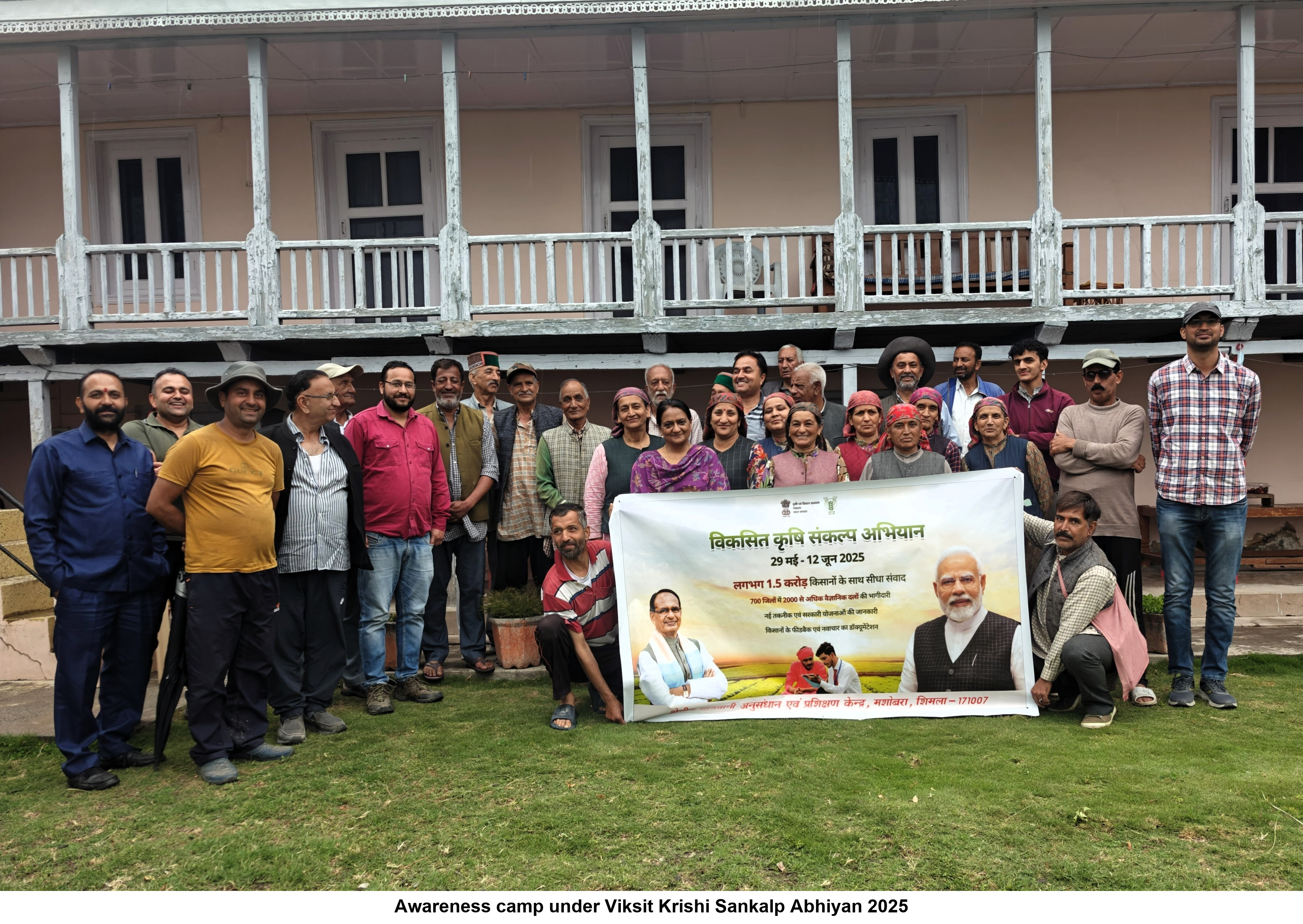
  • Organized on and off campus training programmes (54 nos.), awareness camps (>60), Farmer Scientist interaction/Workshops (05 nos.) and delivered >300 online and off line lectures for farmers, students and extension functionaries during last five years.
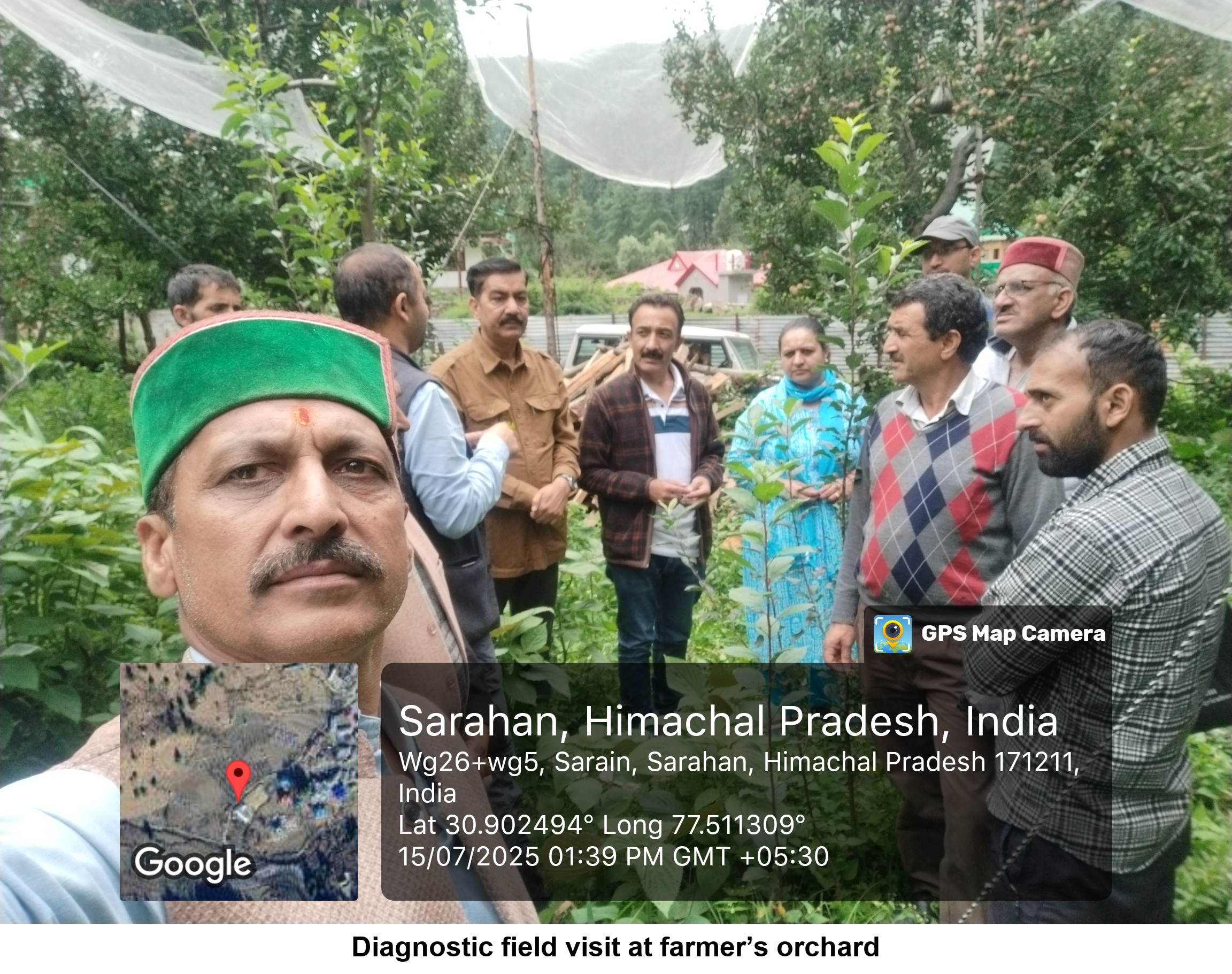
  • Conducted field diagnostic visits (>170 Nos.) at farmer’s field and guided visits (>130) of VIPs, farmers, students, extension functionaries, NGOs etc. at station during last five years.
  • Provided Advisory services through personal interaction, telephonically and farmers visit to station (> 2000 Nos.).
  • Conducted Radio/Television talks (34 Nos.) for dissemination of scientific technology to farmer during last five years.
  • Organized State Level Kisan Mela, Agrifests for school studentsand various exhibitions for highlighting the research and extension activities of research station.

Awards/Recognitions

  • Letter of appreciation received from Hon’ble Vice Chancellor, YSPUH&F, Nauni for outstanding contribution in Apple Day cum Kisan Mela held on August 8, 2022.
  • Awarded First Prize in the Medium-Sized Garden Category among Government Institutions in the Garden Competition in 2024 and 2025 organized by the Shimla Amateur Garden & Environment Society (SAGES).
  • Awarded First Prize in the Bonsai Category during the Flower Show organized by the Shimla Amateur Garden & Environment Society (SAGES), held as part of the Summer Festival from 03rdto 05th June, 2025, in Shimla.

Facilities

  • Infrastructure: Five well equipped laboratories
    • Fruit Science(Nikon Japan Triangular Research Microscope, Research Trinocular Microscope Model MX2i and Digital camera DSLR D5100)
    • Soil Science and Plant Nutrition (Double beam spectrophotometer, Flame photometer, Muffle furnace, Hot air oven)
    • Entomology/Acarology(Phase contrast microscope, Stereozoom microscopes, Mite brushing machine, Stereo Discovery V8 microscope, BOD Incubators, Environmental chamber and Touch Screen Fluorescence Digital Camera (25MP 4K with 13.3” Win 11Tablet) for microscope)
    • Pathology (Molecular diagnostic facilities-Refrigerated centrifuges, PCR Machines, Electrophoresis units, Gel Documentation System, Nano drop, ELISA plate and washer, Microscopes, Incubators etc.)
    • Tissue Culture Laboratory (Autoclave, Leminar flow, Microscope, Hot air oven, Lux meter)
  • Seminar Hall-cum-Museum, Conference Room and Library
  • Meteorological Observatory
  • Five glass houses and seven poly carbonate houses
  • Three water storage tanks in orchard area and three in nursery area
  • Farmer’s Hostel
  • Packing-cum-Grading House

Demonstrations

  • First ever demonstration on production of apple through Natural Farming in high density developed under PK3Y, Deptt. of Agriculture (HP).
  • Demonstration on high density apple cultivation developed under HPHDP (World Bank Project)

Services

  • Quality nursery production of temperate fruit plants for farmers.
  • Production of temperate ornamental plants and landscape plants for farmers and other stake holders.
  • Soil testing services for nutrition management of orchards and other crops.
  • Advisories for farmers though TV/radio talks, social media (facebook & you tube), telephonically and personal interactions (farmer visit to station and field/diagnostic visits at farmer’s field).